Land & Lots
California City land and lots: a guide for owners and buyers
More people own land in California City than live in it. This section is for them, and for anyone thinking of buying a lot: how to find one and read the county's record of it, what to check before paying for one, who is trying to take advantage of owners, and who speaks for them.
Last reviewed · 11 sources
At a glance
- Vacant parcels
- 36,007 vacant residential parcels, 83% of the city’s land, in the city’s 2010 inventory1
- Original buyers
- More than 73,000, from Nat Mendelsohn’s company alone2
- Parcel records
- The Kern County Assessor-Recorder, searchable by parcel number3
- Zoning
- The city’s, on its interactive zoning map4
- Prices and listings
- Not on this site, which does not list lots or estimate what any lot is worth
Who owns the land in California City?
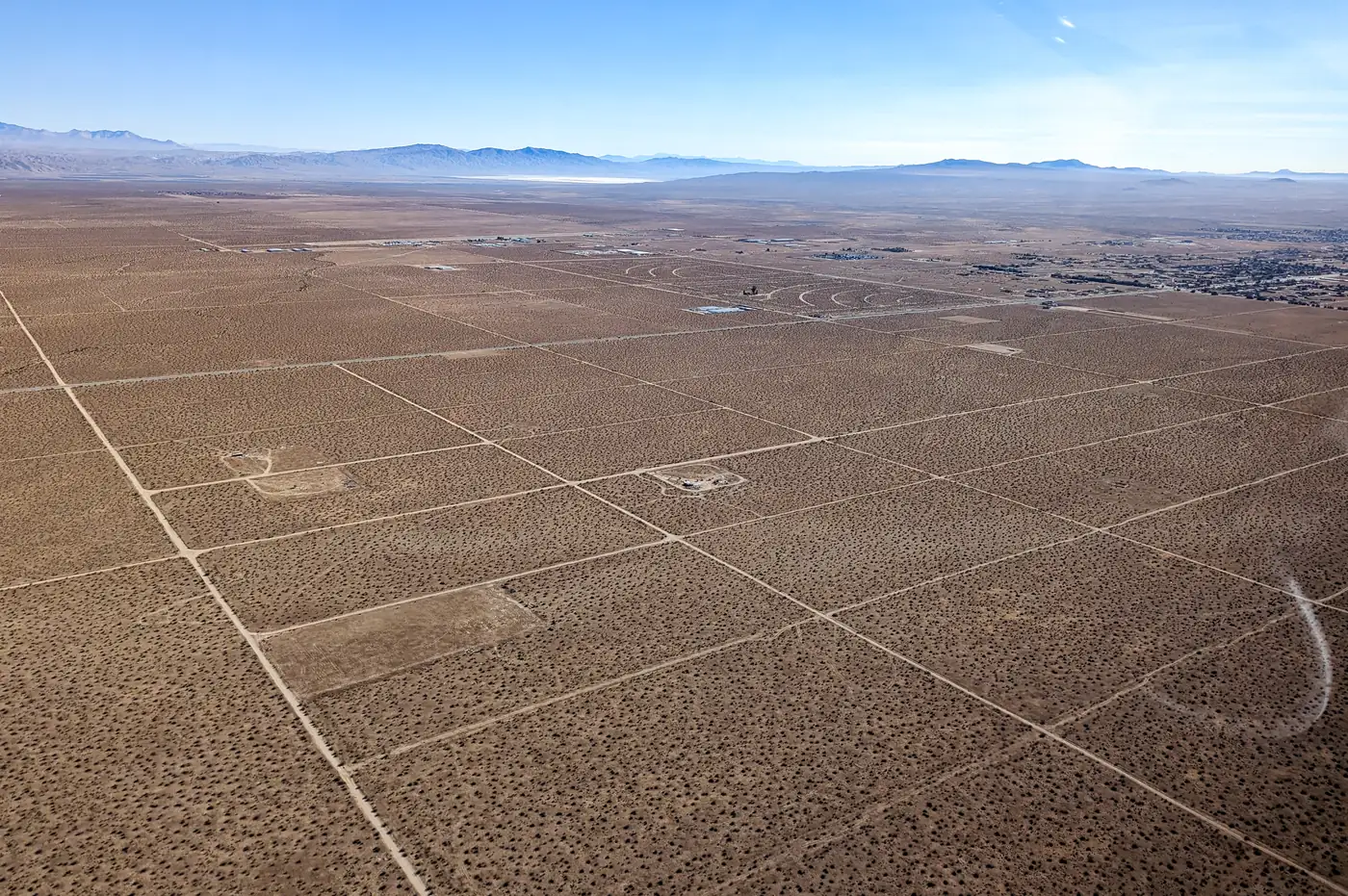

California City’s land was sold far more successfully than it was settled. The city’s own parcel inventory, compiled in 2010, counted 36,007 vacant residential parcels, covering 83 per cent of its land.1 Nat Mendelsohn’s company alone sold land here to more than 73,000 people, and the Silver Saddle “landbank” of the 2010s added more than 2,000 investors.2 The history of the land sales tells how, and the grid map shows what it left: street after named street with nothing on it.
The questions owners ask are concrete. Which lot is mine, and what does the county hold on it? Finding your parcel answers that. Who is trying to scam me? Land scams aimed at lot owners sets out what the regulators warn about. Who speaks for owners? That is the California City Landowners Association. What a lot is worth is not a question this section answers, and it will not be: this site does not estimate the value of any lot.
Buying a lot in California City: what to check first
This site does not list lots for sale, and says nothing about what any lot is worth. What it can do is point to the public records to read before paying for one. Most of them start from the parcel number, which the seller or the listing should be able to give you.
- Read the county’s record. Kern County’s Assessor search finds a parcel by its number and links to its parcel map.3 Finding a parcel explains how to read what comes back.
- Ask whether it is a legal lot, and what it is zoned for. Kern County says an assessor’s parcel is not necessarily a legal lot, and that its maps do not show whether a parcel is a valid building site: that is a question for the planning department of the city it lies in.5 The city publishes an interactive zoning map.4
- Check whether it is in an SDI tract. The city’s code names 29 tracts whose lots are covered by agreements calling for payments by their owners toward improvements to be built later.6 The tract numbers are listed in finding your parcel.
- See what is around it. The county’s record does not say whether a road reaches the lot or whether water could. The grid map shows every platted street and every mapped building near it, though not whether a street is paved. Then go and look, with the precautions for driving out to a lot.
- Know what it costs to hold. Buying resets the assessment: under Proposition 13, property is reassessed to market value when it changes hands.7 For 2025–26 bills, most of the city paid 1.208364% of taxable value, and cities and special districts add fixed charges parcel by parcel.8 The Treasurer-Tax Collector’s bill search itemises them for any parcel’s current bill.9 The property tax rate is explained on the cost-of-living page.
- Make sure the seller owns it. California’s real estate regulator warns of impostors selling vacant land they do not own, typically with fake identification, a notary of their own and a demand for the money to be wired.10 It tells buyers never to wire money in a real estate transaction and to use licensed professionals.11 How to avoid a fake seller has the warning signs.
Holding costs, selling and building: still to be written
Three more guides are planned. They are not written yet.
- What a lot costs to hold. The property tax and every per-parcel charge on a Kern County tax bill, named as the bill names them. Until then, the Treasurer-Tax Collector’s bill search has an “Additional Details” view that lists each taxing agency and fee behind a bill’s total.9
- Selling. The realistic routes, and what each means for a lot with no road or utilities. Until then, the scams page covers the patterns to avoid.
- Can you build on it? Zoning, water, access and permits. Until then, the checks before buying are the starting points, and whether a parcel is a legal building site is a question for the city’s planning department.5
Sources
Every fee, rule, distance and date above traces to one of these, checked on the review date. Rules, closures and fees change: where it matters, confirm with the managing agency before you go. If something here is wrong, tell us and it will be fixed.
- 1.Housing Element Update 2015–2023, Table 5.3: Vacant Land Inventory by Residential Zoning District. City of California City Planning Department, data dated 2010.The city's own parcel inventory. Archived from this domain, which hosted the city's website until 2015.
- 2.60 years of deception and land sales in California City: 7 takeaways from my investigative podcast. Emily Guerin, LAist, 2 September 2020.
- 3.Assessor Property Search. Kern County Assessor-Recorder.How the search works: by APN, by ATN or by street name, never by owner's name, and what the results page links to.
- 4.Interactive Zoning Map. City of California City.The page links to Kern County's online map, opened on the city.
- 5.ParcelQuest Property Search: disclaimer. Kern County Assessor-Recorder.The county's statement that its parcel maps are for assessment only and that an assessor's parcel is not necessarily a legal lot.
- 6.City of California City Municipal Code (PDF edition). City of California City, pages dated 27 April 2011.Sections 1-3.07 and 9-6.101 to 9-6.303: what SDI tracts, lots and agreements are, and how the SDI Fund may be spent. The city marks this edition as being corrected and updated.
- 7.California Property Tax: An Overview (Publication 29). California State Board of Equalization, March 2025.
- 8.County of Kern Tax Rates and Assessed Valuations 2025–2026. Kern County Auditor-Controller-County Clerk.The California City tax-rate areas (code 011-) are on pages 247 to 250; what a rate is made of, the due dates and the per-parcel charges are on pages iii to v.
- 9.Help: searching for and paying a bill. Kern County Treasurer-Tax Collector.
- 10.DRE Urges Real Estate Agents to Be on Alert for Vacant Land Scams. California Department of Real Estate, 30 December 2025.
- 11.DRE Urges California Seniors Watch for Targeted Real Estate and Property Scams. California Department of Real Estate, 19 February 2026.