Land & Lots · Scams
California City land scams: what lot owners and buyers should know
A vacant lot with no mortgage, owned by someone who lives far away and may not have seen it in years, is what the state's real estate regulator says fraudsters go looking for. California City has tens of thousands of them. These are the patterns the regulators describe, and what an owner can do about them.
Last reviewed · 14 sources
At a glance
- The warning
- California Department of Real Estate advisory, 30 December 20251
- What is targeted
- Vacant land owned by people who are elderly, deceased or live far away1
- Usually found out
- When the transfer is recorded with the county1
- Silver Saddle
- The receiver mailed the final distribution on 31 July 20264
- Report
- Local police, sheriff or district attorney; the DRE if an agent is involved1
Is California City land a scam?
The land is real. Every lot is a parcel in Kern County’s records, with its own number, an assessor’s map and a tax bill.2 The scams in California City’s past were in how the land was sold. Nat Mendelsohn’s company sold lots here to more than 73,000 people, and the Silver Saddle “landbank” of the 2010s took in more than 2,000 investors3 before the state brought the case in which a court appointed a receiver.4 The history of the land sales and the FTC’s case and the story of Silver Saddle tell both with their sources.
This page is about what is aimed at owners and buyers now: people selling lots they do not own, and people offering to recover money already lost. Buying a lot is not a scam in itself, but whether a particular lot is worth having depends on things the county’s record does not show, which what to check before buying a lot sets out.
Can someone sell my lot without me?
On 30 December 2025 the California Department of Real Estate warned agents about people posing as the owners of vacant land and asking agents to sell property they do not own. Typically, it said, an impostor uses fake identification to sell vacant land whose owner is elderly, has died, or lives far away.1 It had issued the same warning in July 2023, when it said police and district attorneys around the state were reporting a sharp increase in these cases.5
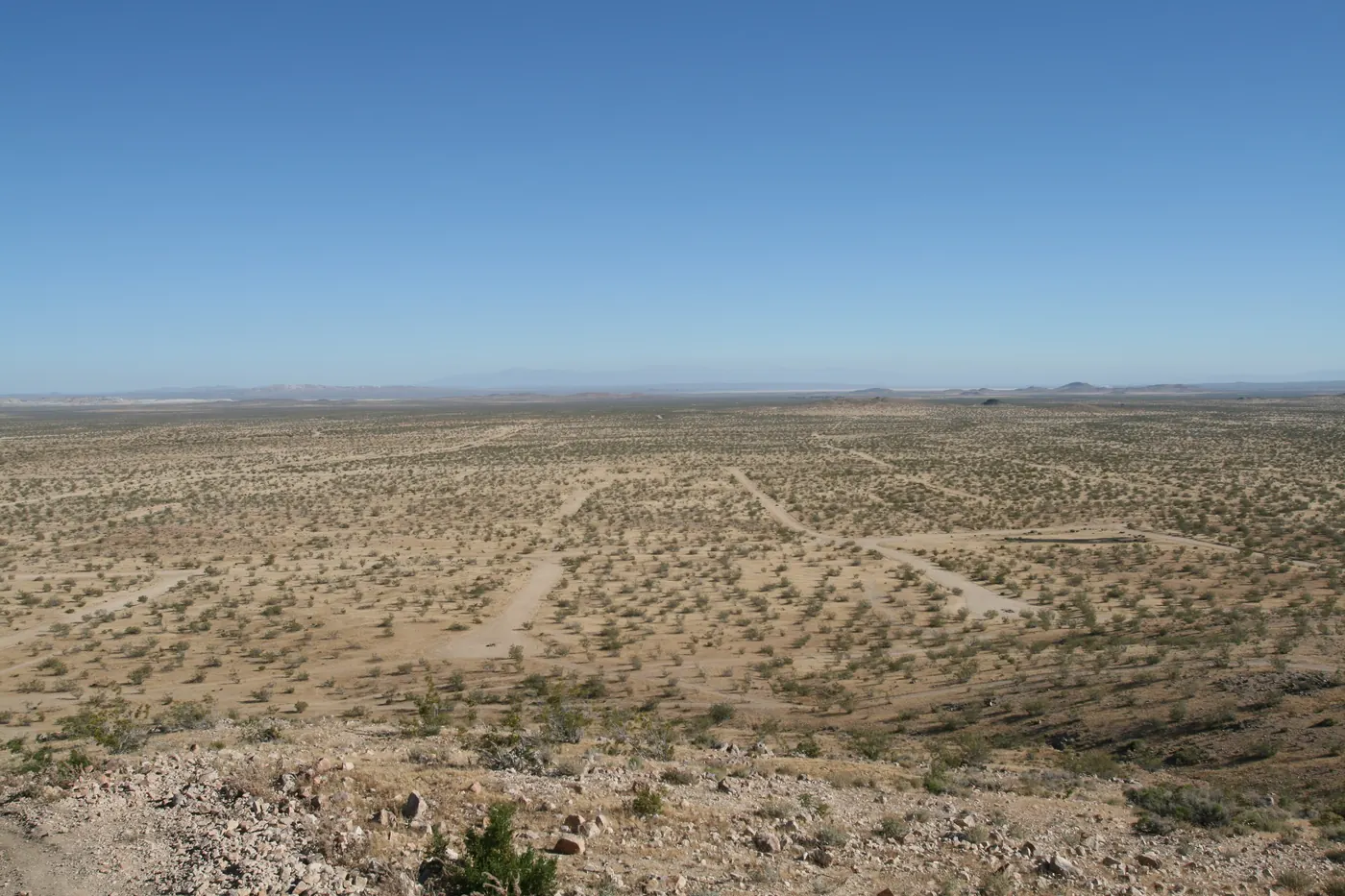
California City fits the description unusually well. The city’s own 2010 inventory counted 36,007 vacant residential parcels,6 and Nat Mendelsohn’s company alone sold land here to more than 73,000 people, through sales offices around the world.3

According to the DRE, the impostor typically:
- searches public records for land with no mortgage or other lien on it, and for its owner;
- asks an agent to list it below market value, to draw quick interest;
- asks for no “For Sale” sign on the property;
- prefers a cash buyer, accepts an offer quickly and wants a quick closing;
- will not meet in person, keeps to email, text and phone, and usually refuses video calls;
- will not attend the signing, saying they are out of the state or the country;
- insists on their own notary, who supplies falsified documents to the title company or closing attorney;
- and wants the proceeds wired to them.
Any one of these can be innocent, the DRE says; several together are the warning. And the scheme is usually discovered only when the transfer is recorded with the county recorder1, that is, once the sale has closed.
How can I protect my lot?
The DRE’s advice is written for agents, but two of its checks run through the owner: agents are told to ask the seller for a recent tax bill, which usually shows the legitimate owner’s name, and to mail a copy of the listing to the owner’s address of record, which alerts a real owner who did not ask for it.1 Both depend on the county having a current address for you.
- Keep your mailing address current with the county. The Kern County Assessor takes changes of mailing address on a form.7 Under a state law passed in 2025, every county must set up a program by 1 January 2027 that mails a notice within 30 days of the recording of a deed, quitclaim deed, mortgage or deed of trust. The notice goes to whoever is named as signing it, at the tax-bill mailing address held before the recording8, so if someone forges your signature on a deed, the notice comes to you, provided that address is yours. When this page was checked, the DRE’s list of counties already running such alerts did not include Kern.9
- Check the record yourself. The DRE tells owners to check the title to their property periodically, as they would a credit report, and to act at once on anything wrong.10 The Kern County Recorder’s online index can be searched by grantor, the party giving up the property,11 so a search on your own name should turn up nothing you did not sign.
- Know your parcel number. It is the way into the county’s record and map; finding your parcel explains where it is printed.
Buying a lot: how do I avoid a fake seller?
A buyer is the scheme’s other victim: the money goes to someone who never owned the land. The pattern above is the one to watch for from the buyer’s side too, above all a seller who cannot be met, has their own notary and wants the money wired.1 The DRE tells consumers never to pay cash, or wire it to anyone, in a real estate transaction, and to use only licensed professionals, whose licences can be checked on its site.10
The county’s online property search does not show owners’ names,2 so it cannot confirm a seller on its own.
Is a Silver Saddle recovery offer real?
The Silver Saddle case, in which more than 2,000 investors bought shares in a “landbank” of desert near the city,3 is told in the history of California City. What matters here is where it now stands, because people who have already lost money are exactly who recovery scams go after.
The court-appointed receiver mailed the final distribution cheques on 31 July 2026, each for 16.8 per cent of the investor’s approved claim. A cheque must be cashed within 90 days of mailing or it is cancelled; after a cancellation, an approved claimant has 45 days to give the receiver’s office a current address for a replacement, or loses the right to a distribution.4 Ninety days from 31 July runs to 29 October 2026.
The receiver’s page describes every step of the claims process: letters by post, challenges by letter or email to its office, cheques by post, changes of address by email to its office. Nothing in that process, as the receiver describes it, involves paying anyone.4
The Federal Trade Commission describes the scam that follows a loss like this one. Scammers buy lists of people who have already been defrauded, then get in touch by phone, email, text, social media or letter, sometimes claiming to be from a government agency, a law firm or a consumer group, and offer to get the money back. First, though, they need a “retainer fee”, a “processing fee” or your bank details. Government agencies and legitimate organisations, the FTC says, never ask for money to help you get a refund.12
Where do I report a land scam?
Sources
Every fee, rule, distance and date above traces to one of these, checked on the review date. Rules, closures and fees change: where it matters, confirm with the managing agency before you go. If something here is wrong, tell us and it will be fixed.
- 1.DRE Urges Real Estate Agents to Be on Alert for Vacant Land Scams. California Department of Real Estate, 30 December 2025.
- 2.Assessor Property Search. Kern County Assessor-Recorder.How the search works: by APN, by ATN or by street name, never by owner's name, and what the results page links to.
- 3.60 years of deception and land sales in California City: 7 takeaways from my investigative podcast. Emily Guerin, LAist, 2 September 2020.
- 4.People v. Silver Saddle Commercial Development, LP, et al.: receivership docket and updates. Thomas W. McNamara, court-appointed receiver (Regulatory Resolutions).The receiver's own dated record of the claims process and the final distribution.
- 5.DRE Urging All Licensees to Be on Alert for Growing Vacant Land Property Scams. California Department of Real Estate, 13 July 2023.
- 6.Housing Element Update 2015–2023, Table 5.3: Vacant Land Inventory by Residential Zoning District. City of California City Planning Department, data dated 2010.The city's own parcel inventory. Archived from this domain, which hosted the city's website until 2015.
- 7.Change a Mailing Address. Kern County Assessor-Recorder.
- 8.SB 255, County recorders: notification (Chapter 351, Statutes of 2025). California Legislature, approved 6 October 2025.Adds Government Code section 27297.7.
- 9.County Recorder Property Owner Alert Program. California Department of Real Estate.
- 10.DRE Urges California Seniors Watch for Targeted Real Estate and Property Scams. California Department of Real Estate, 19 February 2026.
- 11.Search for Recorded Documents or Maps. Kern County Assessor-Recorder.Including the end of online searches by parcel number from 9 December 2024.
- 12.Refund and Recovery Scams. Federal Trade Commission, Consumer Advice.
- 13.ReportFraud.ftc.gov. Federal Trade Commission.
- 14.Filing a Complaint. California Department of Real Estate.