Visiting · Practicalities
Camping in California City and nearby
There are three kinds of camping here: the city's own OHV park in town, free primitive camping on the public land to the north, and the state park campground at Red Rock Canyon. Each has its own rules, and on public land you bring everything, water included.
Last reviewed · 20 sources

At a glance
Where can you camp in California City?
The place to camp in town is Borax Bill Park, a city park rather than a state one, run by California City’s OHV Department as the hub for riders.2 The city lists a visitor centre, first aid station, restrooms, hot showers, fresh water, shade patios and six power-and-water hookups. Camping is first come, first served except where restricted on major holidays, and there is no fee for dry camping.1 The city gives its position as N35°10.278′ W117°50.247′, along Twenty Mule Team Parkway.1
The hookups are charged per night, at a rate that depends on the day. As the city lists them:1
| Night | Power | Water |
|---|---|---|
| Weekday | $25 | $10 |
| Weekday holiday | $25 | $15 |
| Weekend | $25 | $15 |
| Weekend holiday | $40 | $20 |
| Dry camping | Free | |
RV water and dump station. A one-time water fill or dump costs $5, and a season pass $30 per RV. The station is for recreational vehicles only: filling cans, jugs or other containers is prohibited, fills are limited to 100 gallons a day, and the water at the dump station is not drinkable.1
Hours. The dump and water station is open from 6am to 2pm Monday to Wednesday, to 6pm on Thursday and to 7pm on Friday, and from 7am to 6pm at weekends, and around the clock on Thanksgiving, New Year’s and Presidents’ Day. The visitor center is open Thursday to Sunday only.1
The city’s 2025 visitor’s guide sets the camping rules:
Can you camp on your own lot?
Many visitors own a lot in California City and want to stay on it. The city code allows a motor home to occupy a property temporarily only with a temporary use permit from the Planning Director. The motor home must have a self-contained sewage tank, with waste disposed of in a way health officials approve; the stay is limited to 30 days, with one further 30 days possible for good cause; and the property must be returned to its original condition afterwards.3 The permit is a Planning Department matter: contact the city before you go, not after you arrive.
A tent on an empty lot is not a motor home, and the code does not deal with it in the same section. Ask the city’s planning department rather than assume either way.
Where can you camp for free on public land?
Up Highway 14, BLM says the whole of the Jawbone Canyon OHV area and the public land around it is open to primitive camping, and that most sites there can be reached in a two-wheel-drive vehicle towing a trailer.5 Neither Jawbone Canyon nor Dove Springs charges a fee.56 These are primitive sites: State Parks, describing the land laid out among them, says there is no water and there are no hookups, though pit toilets are available in several places.14
- The 14-day rule. BLM allows dispersed camping in California for no more than 14 days in any 28 consecutive days. After the 14th day you must move more than 25 miles from your previous spot until the 29th day, and you may not leave property unattended for more than 10 days.7 BLM’s Jawbone Canyon page also lists a 14-day limit.5
- Pack it out. Campers must not dispose of rubbish, hazardous materials, sewage or grey water in any way that pollutes.7 Where burial is appropriate, BLM’s guidance is 6 to 8 inches deep and at least 200 feet from water and trails; a portable toilet or packing waste out is better.18
- The Rand Mountains. Camping is only allowed in designated areas.8
- The Desert Tortoise Research Natural Area is a nature reserve that its managers list as open from 8am to 5pm,9 and pets are not allowed inside its fence.10
Can you have a campfire?
- Permit. On BLM land a campfire outside a developed campground needs a California Campfire Permit, which is free. BLM also requires a five-foot circle cleared to bare soil and a round-point shovel at least 35 inches long to hand.12
- Seasonal restrictions. In 2026 BLM’s seasonal restrictions apply across the California Desert District, including eastern Kern County, from 15 April to 29 October.13 In Stage I areas campfires are allowed only in approved fire pits and grills at developed sites, and stoves and lanterns with shut-off valves need a campfire permit; in Stage II areas no open fire of any kind is allowed.12
- Red flag days. No campfires during a Red Flag Warning or Fire Weather Watch.12
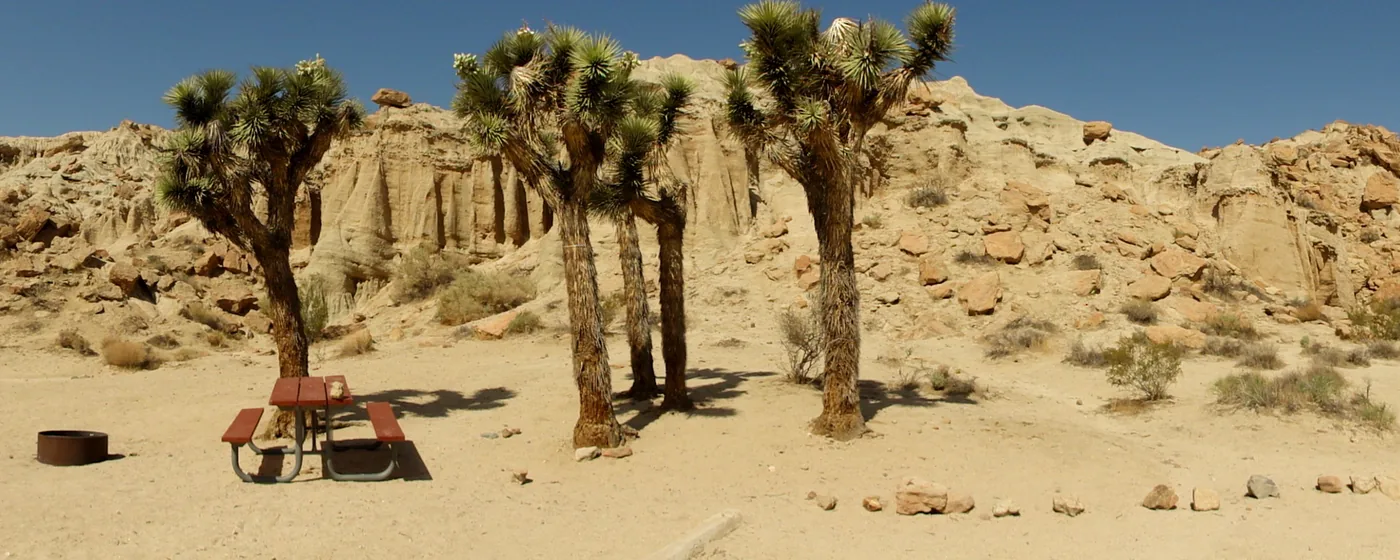
- Red Rock Canyon: fires only in the metal rings at Ricardo Campground.4
Camping at Red Rock Canyon State Park
The state park’s Ricardo Campground has 50 primitive first-come sites with drinking water and pit toilets, and camping anywhere else in the park is not allowed.4 Fees, the RV length limit, the rules and how to get a site on a busy weekend are on camping at Red Rock Canyon.
The campground and Jawbone Canyon are also the darkest of the places this site read on the world atlas of light pollution; see stargazing near California City. If you would rather have a bed, see hotels in California City.
What to expect: heat, cold, wind and water
NOAA publishes no official climate averages for California City itself. The nearest station that has them, at Mojave, averages highs around 97°F in July and August and lows around 32°F in December,19 with about 34 days a year reaching 100°F and about 40 nights at or below freezing.20 The city warns that conditions can quickly turn dangerous, with extreme temperatures and high winds, and recommends a gallon of water per person and riding before 10am or after 4pm in the heat.2 Friends of Jawbone says to carry at least a gallon per person per day and not to ration it.15 Before you go, the desert conditions page rates the coming weekend for camping from the latest NWS forecast, overnight wind and lows included.
The city also warns of venomous snakes, including the Mojave rattlesnake.2
Sources
Every fee, rule, distance and date above traces to one of these, checked on the review date. Rules, closures and fees change: where it matters, confirm with the managing agency before you go. If something here is wrong, tell us and it will be fixed.
- 1.About Us (OHV Department: permits and Borax Bill Park). City of California City.Permits, Borax Bill Park's facilities and hookup charges, and the RV dump and water station policy and hours. Re-read 24 September 2026.
- 2.Borax Bill Visitor's Guide. City of California City OHV Department, 2025.
- 3.Code of Ordinances, City of California City: Title 7, Chapter 5 (Parks) and Title 9. City of California City, via Municode, codified through November 2021.Park hours, dogs, the lake, fishing, boating, camping permits, and temporary occupancy of a lot in a motor home.
- 4.Red Rock Canyon State Park. California State Parks.The park's official page: directions, hours, fees, camping, dogs, vehicles, drones, closures and contacts. Its current-restrictions panel was empty when checked.
- 5.Jawbone Canyon OHV Area. Bureau of Land Management.
- 6.Dove Springs OHV Area. Bureau of Land Management.
- 7.California Recreation Activities. Bureau of Land Management.The California rule on dispersed camping: 14 days in any 28, then move beyond 25 miles.
- 8.Rand Mountains Management Area permit and map. Bureau of Land Management, 23 March 2026.The free permit itself, with the area's rules, history, tortoise information and the 2026 closure notice.
- 9.Overview & Location: Desert Tortoise Research Natural Area. Desert Tortoise Preserve Committee.
- 10.Visiting the DTRNA. Desert Tortoise Preserve Committee.
- 11.West Mojave Plan route network. Bureau of Land Management.BLM's notice of the court-ordered closure of routes in desert tortoise critical habitat to OHV recreation from 24 March 2026, the areas that remain open, and the Rand Mountains permit.
- 12.California fire information and restrictions. Bureau of Land Management.Current restrictions by field office, including Stage I rules for Ridgecrest and the free California Campfire Permit.
- 13.BLM announces seasonal fire restrictions for southern California. Bureau of Land Management, 14 April 2026.
- 14.Onyx Ranch SVRA. California State Parks, Off-Highway Motor Vehicle Recreation Division.The state vehicular recreation area laid out in a checkerboard among the BLM land at Jawbone and Dove Springs; states that no water or hookups are available for camping in the area.
- 15.Safety. Friends of Jawbone.
- 16.Flash Floods: Tread Safely. Bureau of Land Management.
- 17.Turn Around Don't Drown. National Weather Service.
- 18.Camping. Bureau of Land Management.
- 19.U.S. Climate Normals 1991–2020, monthly: Mojave, CA (USC00045756). NOAA National Centers for Environmental Information.The nearest station with official normals, about 11 miles west-southwest of California City in a straight line. There is no normals station in California City.
- 20.U.S. Climate Normals 1991–2020, annual and seasonal: Mojave, CA (USC00045756). NOAA National Centers for Environmental Information.